Plot-Level Proof: Building EUDR Evidence Through Balkan and Ukrainian Supply Chains
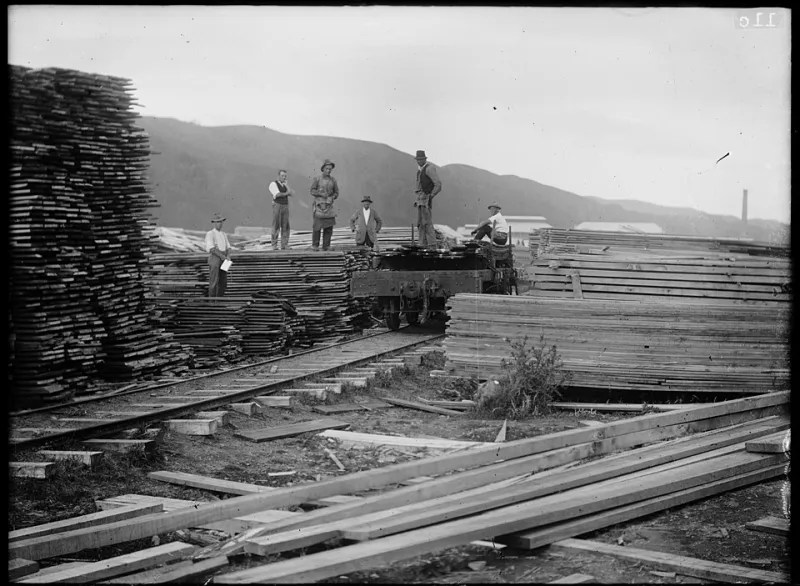
Photo: National Library NZ on The Commons, No restrictions, via Wikimedia Commons
For most UK businesses caught by the EU Deforestation Regulation, the compliance question is not whether a forest was cleared. It is whether the evidence proving that it was not cleared can survive three or four intermediaries before the goods reach an EU border. When those intermediaries sit in Serbia, Bosnia and Herzegovina, North Macedonia, Moldova or Ukraine, that evidence has a habit of thinning out.
The regulation, Regulation (EU) 2023/1115, covers seven commodity groups: cattle, cocoa, coffee, oil palm, rubber, soya and wood, together with a long annex of derived products that reaches into furniture, leather, tyres, chocolate and printed paper. Its application has been rescheduled more than once, so the first practical step for any 2026 consignment is to confirm the operative date for your product line and your company size with your EU importer, rather than relying on last year's briefing note.
Operator, downstream operator, and the chain in between
The obligation attaches when relevant goods are placed on, or exported from, the EU market. The business doing that is the operator and must lodge a due diligence statement in the EU information system, obtaining a reference number that travels with the consignment. Anyone further down the chain who makes the goods available, such as a distributor or a manufacturer using imported timber, is a downstream operator and must quote that reference.
A UK exporter is often none of these things. But its EU customer cannot file a statement without plot-level data, and that data has to come from the top of the chain. In practice, UK firms are being asked to act as the data conduit even where the legal obligation sits elsewhere. Where a UK business has an EU subsidiary that imports, the subsidiary carries the obligation directly and group treasury should assume the parent will be asked to stand behind the data.
What geolocation actually demands of a Balkan leg
Geolocation is more exacting than a certificate of origin. For plots above four hectares the submission needs a polygon, a closed boundary of the production land, with latitude and longitude; for smaller plots a single point is accepted. It also needs the date or range of production, the species involved and the quantity. Every plot contributing to a consignment must be accounted for.
This is where aggregation hurts. A container of hardwood furniture assembled in Serbia may draw on sawn timber from Bosnia, veneer from Croatia and fittings from North Macedonia, each from a different mill, each mill buying from a cooperative of small private forest owners. Multiply four hectares by several hundred smallholders and the polygon requirement becomes an exercise in data collection rather than compliance. The regulation does allow a risk-mitigation route where plot data is genuinely unavailable, but it demands documented evidence of the steps taken and is far harder to defend in an audit than clean coordinates.
Where the chain usually breaks
Three failure points recur.
The first is the aggregator who cannot identify the upstream operator. Cooperatives and traders frequently buy on the open market without recording the holding from which timber or soya originated. Ask early, in writing, and ask for the name of the entity that filed any upstream statement.
The second is the processor who treats compliance as a sales document. A sawmill in the Western Balkans may be able to produce a certificate of origin and a phytosanitary certificate, but not a plot boundary. Those documents answer different questions, and substituting one for the other is the most common error we see in supplier files.
The third is legal form. Data requests written in English and governed by English law are easy to ignore. Build the obligation into the purchase contract, with a delivery deadline measured against the shipment date, a defined data standard, audit rights and an indemnity that bites.
Ukraine: a special case in the east
Ukraine is a meaningful supplier of timber and soya to EU markets, and its exporters are in principle well served by electronic timber accounting. The practical difficulties lie elsewhere. Cadastral and forest-management records in areas affected by hostilities may be incomplete or unreachable; documentation chains can break for reasons that have nothing to do with deforestation; and any gap invites a conservative risk assessment from an EU importer.
UK buyers sourcing Ukrainian material should expect their EU counterpart to demand more evidence, not less, and should budget time for it. Where a supplier genuinely cannot produce polygons, the mitigation file has to be assembled deliberately rather than improvised at the border. That means retaining the requests made, the responses received, the reasoning applied and the alternative verification used.
A readiness checklist for 2026 consignments
- Map every product line against the commodity and derived-product annexes, including packaging and printed material.
- Identify who files the due diligence statement and obtain the reference number in writing for each shipment.
- Trace each consignment to the plot of production, not merely to the country of export.
- Confirm the data format your EU customer requires; polygons in WGS84 are the working standard.
- Record production dates and quantities, and reconcile them against commercial invoices.
- Obtain the species name in Latin and check it against what is on the pallet.
- Review each supplier region against the Commission's benchmarking and keep the assessment on file.
- Handle personal data lawfully: smallholder names attached to boundaries engage UK GDPR and EU GDPR, so share only what is necessary.
- Write data-delivery obligations, audit rights and indemnities into the purchase contract, with a deadline before shipment.
- Maintain a mitigation file for any consignment with incomplete plot data, showing what was asked for, what arrived and why it was sufficient.
The commercial point
This is one of the few border regimes where a UK firm's leverage is contractual rather than regulatory. Nothing in the regulation obliges a Serbian sawmill to hand over a polygon; the purchase order does. Exporters who write that requirement into their standard terms this year will spend 2027 shipping. Those who leave it to email will spend it explaining.